
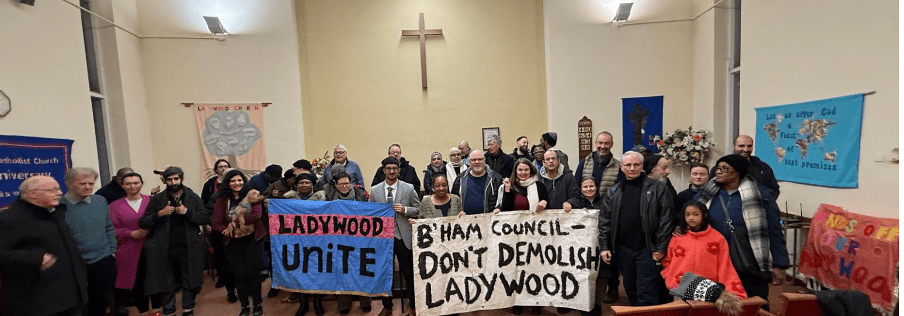
Resident reflections on visit from Geoff Bell, Woodberry Down, London
DISCLAIMER:
By reading this blog, you should be aware that the views and opinions expressed are those of local residents who attended a discussion with Geoff Bell. They do not necessarily reflect the views of any official body, local authority, developer, Geoff Bell himself, or other stakeholders involved in the Ladywood regeneration project.
This blog is intended for informational and discussion purposes only. Whilst every effort has been made to ensure an accurate reflection of participants in discussion, the content highlighted includes personal opinions, observations, and interpretations based on available information at the time of writing. Regeneration plans are subject to change, and no guarantees are made as to future outcomes.
Nothing in this blog should be construed as factual assertion, legal advice, or a definitive prediction of events. The authors and publishers assume no responsibility for any errors, omissions, or changes in circumstances which could potentially arise at any stage whatsoever. Any reliance on the content is at the reader’s own risk.
Comments and contributions from third parties remain their own and do not reflect the views of the authors or publishers. Readers are encouraged to seek independent verification and professional advice before making any decisions or judgments based on this literature.
By continuing to read and engage with this blog or any literature supplied by Ladywood Unite, you acknowledge and accept this disclaimer.
Introduction
If the agreement with Berkeley Group is signed, these things could happen to people in Ladywood like they did to people in Woodberry Down, London. Woodberry Down is in the middle of their regeneration, and it is of a similar size to Ladywood. Please note, this is the opinion of residents listening to Geoff Bell. It is not necessarily what will happen here.
Homeowners
Homes may be taken from homeowners and may be replaced with a home for another person. The person who loses their home is not offered a ‘like for like’ replacement. If shared equity or shared ownership is offered, people do not usually take it because it can prevent parents giving homes to their children. Shared equity or shared ownership can also become more expensive. Most homeowners move out of the area.
There are not many private, freehold homeowners in Woodberry Down – most are right to buy, leasehold. However, the government does appear to be trying to demolish the few private homes now. This may be difficult given the environmental costs of demolishing good quality housing. It was decided in Woodberry Down that, in principle, good quality homes would not be demolished, but it is unclear whether this was/is always followed.
Council tenants won the right to return in Woodberry Down, something that was recognised in the community charter. This principle is not yet in the Ladywood charter. In Woodberry Down, housing was re-provided to council tenants who had their homes demolished. The new and re-provided housing can be quite nice, although there have been issues with Berkeley Group’s windows. Unfortunately, the new housing can be more expensive. The council can increase charges every year.
Council tenants may be offered a home to meet their current needs as opposed to being offered a like for like home. The new housing could be a different size than previously. For example, the council might determine that people no longer need a large home because their families have become smaller. In Woodberry Down, council tenants needed to move multiple times. In contrast, in Ladywood, we have been promised a single move in a build first approach, but this is not guaranteed.
Community spaces
Berkeley Group might promise to provide community spaces, such as community centres or daycares. However, they might be unfordable for the community to use once built. There is the question of who maintains these spaces, and the council is often unwilling or unable to do so. When renting a space costs £100s of pounds for several hours, it is difficult for community organisations to afford this. We should be cautious about offers to provide community spaces that become too expensive for the community to use.
Churches
Berkeley Group reportedly did not demolish any churches in Woodberry Down.
Businesses
In order to attract new, wealthy people to live in the area, Berkeley Group will likely ask expensive restaurants to locate to the area. These are likely to be unaffordable and unattractive to the people already living in the area. Many investors are from foreign countries. Berkeley group demolished a pub in Woodberry Down but not a church. They also demolished a tree near a pub despite great protest. There is a legitimate concern that local businesses could be negatively affected by the regeneration.
Community power
Local government in Woodberry Down provided funding for a community group to support the residents. One resident for every two blocks was elected for the group, and this was done in by phases. However, the group has had little true power to influence the regeneration, apart from through the media and public opinion. Consultation is tokenistic at best, meaning views are listened to – but not necessarily taken on board. Planning committees are unpredictable and do not always make decisions in the interest of the residents, but they should be approached directly to influence them.
Berkeley Group
As a private developer, Berkeley Group will be focussed on viability (profit) and ensuring their 20% profit. For the most part they did not appear to be working in the interests of residents and will have their shareholders as their primary interests. Therefore, it is important that local government advocates for residents, and that residents advocate for themselves.
Alternative plan
The residents of Woodberry Down did not have an alternative plan. However, they would have been in a more powerful position if they had their own plan of how the area should look. As it was, they were always reacting to Berkeley Group’s plans rather than putting forward their own. It would have strengthened their approach to have an alternative plan.
Conclusion
As a developer, Berkeley Group are not the worst of the lot. However, there are risks of serious losses for homeowners and businesses, and concerns about rising expenses for council tenants and in community spaces. Most things were demolished throughout Woodberry Down. An alternative plan is one way of fighting these issues, however, it is not the only way. Although politicians do not tend to be very helpful, there are also legal strategies, use of the mass refusal to move, protests and campaigning, and more.

 Ladywood Unite
Leave a comment