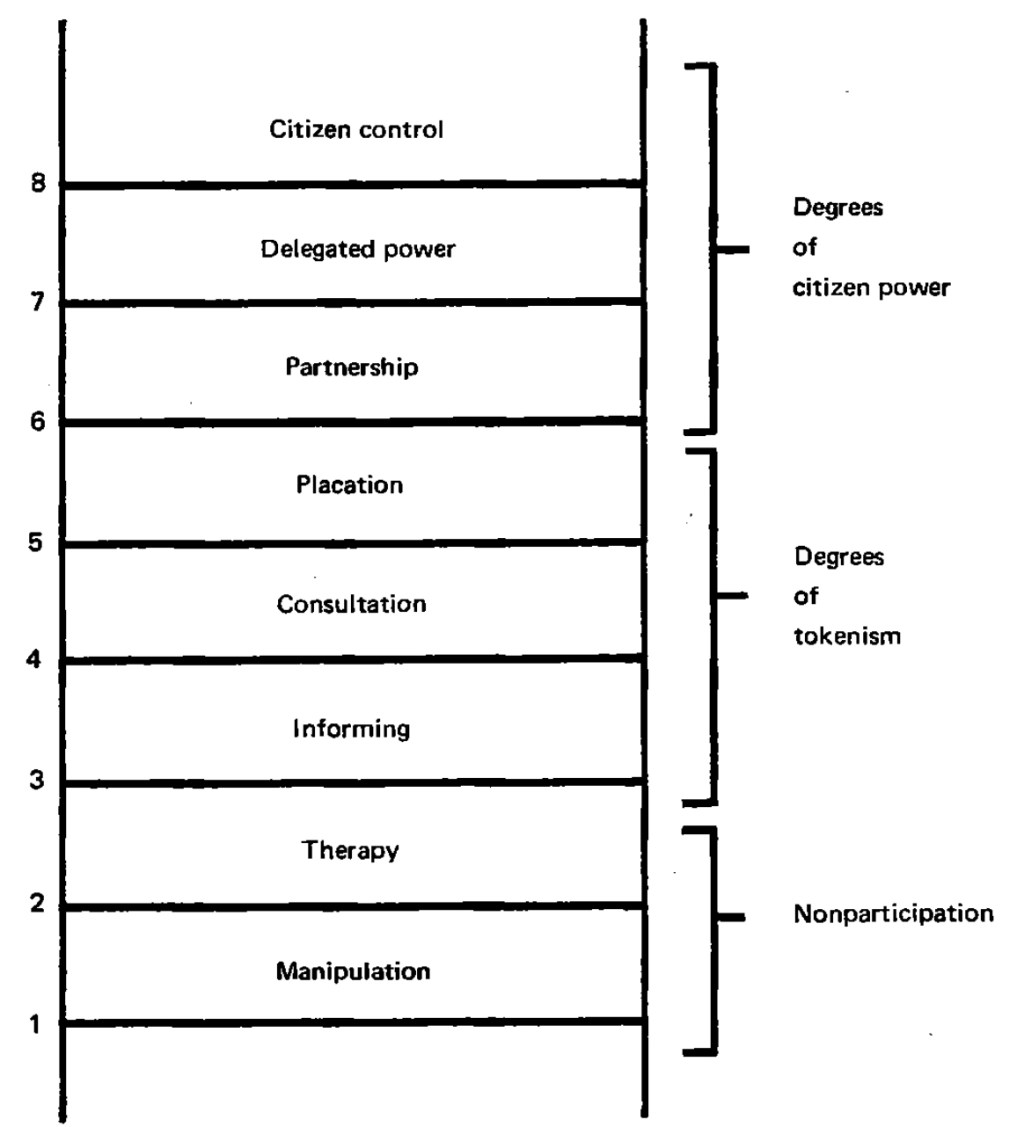
In an article published in 1969 titled “The Ladder of Participation,” Sherry Arnstein made distinctions between the different ways citizens are involved in decision-making and policies. At the bottom, there was manipulation and therapy, mostly consisting of placing people on “rubber stamp advisory committees” that give the illusion of participation. Then, there are informing and consultation and placation. They are mostly tokenistic forms of participation that revolve around informing people about the process and running surveys and consultations, without giving people real power to affect decisions and policies. At the top, partnership, delegated power, and citizen control give people different degrees of authority over management, planning, and policies, and funding and administrative capacity to do that.
What we have witnessed in Ladywood is a mostly tokenistic form of participation ranging between informing and placation, with some level of manipulation.
In June 2019, Ladywood councillors issued a first leaflet pledging their commitment to help residents lead the regeneration process and inviting residents to join a Steering Group for that purpose. In August 2019, the councillors promised that a meeting would be held in early autumn that year. In October, councillors reiterated their commitment to support a Steering Group and urged residents to wait for the Council to appoint a person “to work for and together with” them and “proper engagement in developing the plans”.
In December 2019, councillors stated that a role description for the Central Ladywood Regeneration (CLR) community organizer had been drafted and that councillors “will make sure that the person appointed knows what we expect of him/her”. The letter ended with a request to wait: “please be patient. It’ll be worth at the end”. The promise of a community organizer was reiterated in the 2019 Christmas newsletter.
As it can be read from the result of a FOI request, a formal procurement process had already begun in April 2019, and not permitting wider consultation. Councillors’ call for consultation was erroneous and potentially disingenuous.
Then, in October 2023, Birmingham City Council then launched its engagement initiative with the aim of drafting a Community Charter.
In principle, the Community Charter is a document that lists the council’s commitments to residents. As such, the charter sets out legitimate expectations and if failing to fulfil them, following common law, the council is potentially subject to judicial review.
For that purpose, BCC carried out a series of 12 engagement workshops in October and November 2023. However, the participation was capped at only 20 participants for each workshop, which limited opportunities for meaningful and inclusive engagement.
The activities carried out at these engagement workshops were not sufficiently and appropriately designed to produce such a charter.
The workshop began with the council’s representatives delivering an overview of the project, and were followed by group workshops which aimed to elicit participants’ evaluation of their concerns, possible solutions, what they valued to be important and what participants wished to know more about. Participants were asked to add sticky notes and circle and comment on any promising ideas on a large piece of paper.
The questions asked were too generic and the methodology used to elicit responses too undefined to be fit for purpose. At the outset, the engagement workshops were presented and designed as information sessions and were not conducted as hands-on activities focused on producing an output, the significance of which was not fully explained to participants.
A survey was then launched a couple of days before Christmas to last until the end of February.
Structured in 4 parts the survey invites participants to state their priorities over a range of topics from trust and the importance of community involvement to compensation, rehousing options, parking options, and green spaces. Four videos accompany each of the parts detailing the range of feedback and suggestions BCC received in its workshops.
The clustering of so many topics in one survey and uncertainty of how the feedback is going to be used remain a reason for concern.
For meaningful participation to happen, there is a need for a greater commitment to guarantee citizen power, and that would involve, among others:
• Residents be consulted on a preliminary draft of the Community Charter, with the possibility of rerunning engagement workshops with the intent of rephrasing and reframing the draft of the charter.
• Residents to be involved in the design of future surveys
• Residents to be involved in the elaboration of the Stakeholder Engagement Strategy, the Stakeholder Mapping, and the elaboration of the Stakeholder Engagement Management Plan.
• Residents to be involved in drafting the job descriptions of the Stakeholder Manager and Officer.
• The parts concerning the design of the indicative Master Plan agreed in the Development Agreement be published
• Residents to be given representatives on the Ladywood Project Board and to allow residents to choose their representatives to sit on the Ladywood Project Board
• Residents to be given the capacity to affect the design of the Master plan for the area as well as and policies concerning the housing provision for the existing community of Ladywood

 Ladywood Unite
Leave a reply to Anonymous Cancel reply