
Ladywood Unite understands that the council’s Ladywood Resident Steering Group, led by ARK, has voted to approve a Code of Conduct, Terms of Reference and Conflict of Interest statements.
We also understand that four residents voted against these documents, four residents voted in favour, and two non-resident stakeholders voted in favour. This means the documents were passed despite only half of resident members supporting them.
In a process that is meant to be resident led, this is deeply concerning.
Below we set out why. We also share the documents at the end of this post.
1. The Terms of Reference and Code of Conduct function as a ‘gag order’
The documents require members to “abide by and support Steering Group decisions when representing the Steering Group in the wider community and not seek to undermine the Steering Group’s activity by briefing against the group”.
This effectively prevents residents from publicly questioning the legitimacy, structure or decisions of the steering group. Disagreement can be framed as undermining, creating a chilling effect on residents who raise valid concerns.
In our view, this silences dissent and protects the process of the council and developers, not the community.
2. Residents are given responsibility without power
Despite the demands placed on them, the steering group has no formal power to influence outcomes. It cannot veto plans, it does not control key decisions, and residents have no seats on the main decision making board. Only the council and the developer have these.
This is a step backwards. In Ladywood’s regeneration in the 1990s, residents had board seats. In other regeneration schemes, including led by our developer, residents, at times, had meaningful decision-making power. Here, we do not.
We also understand the developer has described the steering group as a focus group. This suggests residents are being used to extract information, rather than to shape outcomes.
3. Residents are expected to do the council’s job for free
The Terms of Reference state that steering group members are responsible for ensuring residents affected by the regeneration:
“receive accurate information, are fully consulted with and able to give their views about what is proposed in the project” and “to ensure that residents are fully informed about their rights and that all processes reflect their rights and entitlements”
These are duties of the council and the developer. Shifting this responsibility onto unpaid residents blurs accountability and places an unfair burden on community members.
4. Non residents can vote, but residents lack protected space
Non resident stakeholders have voting rights on the resident steering group. At the same time, there is no regular resident-only space where residents can meet, discuss concerns freely or build shared positions.
We understand that stakeholders, by contrast, have had protected stakeholder-only spaces for years. This imbalance weakens resident voice and collective power.
5. The resident steering group is not democratically elected
Steering group members are not elected by residents. In a process that affects people’s homes and lives, this represents a serious democratic deficit. Ladywood Unite leafleted the entire regeneration area in order to elect its members. This is not an impossible task, particularly for organisations like the council and developers who have resources.
6. Residents can be removed by a minority coalition
Any member can be dismissed by a majority vote. Given the voting structure, this means only half of residents, combined with non resident stakeholders, could remove residents who challenge the process.
This undermines independence and discourages residents from speaking openly.
7. Agenda setting power sits with a council funded organisation
Although members may suggest agenda items, the final decision rests with the Chair and Vice Chair from ARK:
“Steering Group members will be contacted to agree proposed agenda items, and the Chair and Vice Chair will confirm the proposed agenda”.
This gives a council funded organisation ultimate control over what is discussed, and what is not.
What we are calling for
If the Ladywood regeneration is genuinely to be resident-led, the process must change. At a minimum, we are calling for:
• Resident majority for any resident steering group decisions
• Removal of gag-style clauses that restrict residents’ ability to speak publicly or disagree
• Meaningful decision-making power for residents, including board representation and veto rights
• Ensure accountability and transparency of the steering group, with all discussions and documentation shared openly with residents and the wider public
• Regular, protected resident only spaces to meet and build shared positions
• Democratic selection or election of resident representatives
• Clear accountability for consultation and information sharing to sit with the council and developer, not residents
• Independent agenda setting, not controlled by a council funded organisation
How this aligns with Ladywood Unite’s principles
These concerns are not procedural quibbles. They go to the heart of Ladywood Unite’s shared principles.
Community Power and Accountability
Residents must hold real power, not just advisory roles, and the council and developer must be accountable to them.
Respect, Inclusion and Resident Led Outcomes
Residents must be able to speak openly, disagree and shape decisions without fear of exclusion.
Equitable Participation
Residents should not carry unpaid labour or responsibility without authority, and non residents should not outweigh resident voices in resident forums.
In short, residents are being asked to lend time, legitimacy and labour to a process in which they hold limited power, and where key rules were approved against the wishes of most resident members.
Ladywood deserves a regeneration process built on democracy, dignity and genuine community control. We will continue to push for a process that reflects those values.
_________________________________________________________________________________
Ladywood Resident Steering Group (RSG)
Code of Conduct
Purpose of the Code of Conduct
1.1 This Code of Conduct sets out the standards of behaviour expected from all members of the Resident Steering Group (RSG). It aims to promote mutual respect, transparency, and accountability, ensuring that all members contribute positively and constructively to the regeneration process.
1.2 By joining the Steering Group all members of it are bound by this Code of Conduct and its observance. This Code of Conduct should be reviewed annually at the same time as the committee reviews its membership and terms of reference.
2.0 Core principles
2.1 All Steering Group members are expected to support the broad aim of improving the social, economic, and environmental wellbeing of Ladywood and of this Steering Group’s role in progressing this project. This does not mean members of the Steering Group has to agree with every proposal made, but they cannot be a member if they cannot support the legitimacy of the project or the Steering Group.
2.2 Steering Group members are expected to.
- Act with integrity in their engagement with the Steering Group and its activities.
- Treat all participants, staff, and partners with respect, dignity, and courtesy.
- Take personal responsibility for your participation and decisions.
- Act in a manner that supports inclusion, respect and reflects the diversity of the community.
- Ensure transparency and accountability in how decisions are made within the Steering Group and in the overall regeneration process.
- Ensure confidentiality by protecting sensitive information shared within meetings.
- Work in a manner that develops collaboration, working constructively with others for the collective benefit of residents and the wider community.
- Declare any personal interests that might influence your participation.
3.0 Responsibilities of Members
3.1 For the effective conduct of meetings, Steering Group members are expected to:
- Attend meetings regularly and on time and give apologies where necessary.
- Read papers and prepare for discussions in advance.
- Listen respectfully to others and allow everyone the opportunity to contribute.
- Focus on the agreed agenda items and objectives of the Steering Group.
- Represent the broader interests of all residents, not just individual or block concerns.
- Share accurate information with other residents and the community in an appropriate way.
- Uphold the integrity and reputation of the Steering Group in all public communications.
4.0 Confidentiality
4.1 Some information discussed within the Steering Group may be commercially sensitive or personal, members must not share or publish such information without prior consent. Meeting papers marked ‘confidential’ must not be circulated outside the group. Breaches of confidentiality may result in removal from the Steering Group.
5.0 Conflict of interest
5.1 Members must declare any personal or financial interest in matters under discussion. Declarations should be made at the start of meetings and recorded in the minutes. Members with a conflict may be asked to abstain from certain discussions or decisions.
5.2 Examples include:
- Having a personal, organisational, or financial interest in a public authority, contractor or developer involved in the project.
- Having a close family member employed by the regeneration partners.
6.0 Equality, Diversity, and Inclusion
6.1 The Steering Group values the diversity of the community and is committed to equality of opportunity. Members must not engage in any form of discrimination, bullying, harassment, or intimidation. All members are expected to contribute to creating a welcoming and inclusive environment.
7.0 Conduct at meetings
7.1 Everyone attending the Steering Group should be given a fair hearing and listened to with respect, tolerance, and an open mind. Everyone attending meetings should treat each other as equals and with mutual respect. Whilst attendees may have different positions, they should expect and display the above.
7.2 Members should try to have as open as possible discussion of issues as they develop. This is about working together through difficult items and being honest if there are disagreements but doing so in a productive environment respecting different views in a respectful manner.
7.3 Steering Group members should be committed to taking any factual evidence or professional advice presented to them into proper account when taking decisions. Of course, members can question evidence, debate its meaning, or choose to ask for more information or options. Essentially all members have a reasonable right to expect their colleagues to approach decision making in a rational manner based on the available information.
7.4 Visitors to the Steering Group should treat members of the Steering Group with respect. When a visitor is present, any member of the Steering Group can ask for the meeting to have a break at any time and by consensus, ask the visitor to leave.
7.5 Members should make decisions objectively about what would be beneficial for the affected residents and community as a whole rather than what may benefit their particular immediate area, property, or situation.
7.6 Attendees of the Steering Group are expected to:
- Speak through the Chair when addressing the group.
- Refrain from interrupting, shouting, or using offensive language.
- Avoid dominating discussion or undermining others’ contributions.
- Respect agreed time limits and the Chair’s direction.
8.0 Communication outside meetings
8.1 It is important that the Steering Group has control over statements or communications made on its behalf or by its members to third parties. No members or officers should seek to make comments on behalf of the Steering Group without either being sure they are conveying a clearly agreed position or agreeing their intended remarks beforehand with the Steering Group. They should also not undertake communications that breach the Code of Conduct or could bring the Steering Group into disrepute.
8.2 This means that Steering Group members are required to respect a decision that they personally disagree with if it has been agreed by a majority decision or vote. They may only acknowledge their personal disagreement in public if they are able to do so respectfully. They must not misrepresent the Steering Group’s settled position, question its legitimacy, or imply that the decision itself should be revoked. They must recognise that other members of the Steering Group may, in good faith, arrive at different conclusions, and that the Steering Group needs to be able to finalise decisions even when complete consensus cannot be reached. Members may continue to express their disagreement inside the meetings, but they should recognise that continued objections to settled decisions may be disruptive to the goals of the Steering Group. If a member wishes to actively campaign or to criticise the legitimacy of the Steering Group or the integrity of its members in public, they are obliged to resign.
9.0 Non-discrimination
9.1 All members are expected to adhere to the principles of the BCC Equality and Diversity Policy in terms of their conduct in meetings and in their decision making.
10.0 Breaches of the Code
10.1 Potential breaches of the code should be forwarded to the Chair in writing in the first instance.
10.2 Any alleged breach will be reviewed initially by the Chair with appropriate advice and support. The member concerned will be given the opportunity to explain their actions.
10.3 If there is a case to answer, the Steering Group will be convened and the outcome of the investigation outlined with proposed actions. The Steering Group will either by consensus or vote (if no consensus is reached) determine the appropriate sanction (if any), sanctions may include:
- Verbal or written warning and details re future expectations
- Suspension from meetings
- Removal from the RSG (in serious cases)
Ladywood Resident Steering Group (RSG)
Terms of Reference (ToR)
1.0 Background
1.1 Birmingham City Council (BCC) have identified the need for a large-scale regeneration of the Ladywood estate. This is aimed at improving the sustainability of the neighbourhood and the quality of life of its residents.
1.2 The regeneration project is likely to last several years and have a number of phases. This will likely go from master planning and agreeing what needs to be done to regenerate the estate, implementing the construction and remodelling work this will entail in phases, and then developing the management and community support structures for the estate post redevelopment.
1.3 Enabling the community to have a prominent and meaningful role in this process working with delivery and community stakeholders is seen by BCC as fundamental to both its approach and long-term success.
2.0 Purpose of the Resident Steering Group
2.1 The Resident Steering Group (RSG) has been established to inform key decisions in relation to the project, monitor its progress and ensure that all residents are fully informed and consulted about what is happening as well as how it may impact them. It will also ensure that all residents have the opportunity to make their views known on what is proposed and how the process is being implemented, and that this feedback is considered as part of its deliberations.
2.2 The RSG provides a structured forum for residents to:
- Influence the design, delivery, and phasing of the regeneration project
- Represent the interests of tenants, leaseholders, freeholders, businesses and other stakeholders.
- Work collaboratively with BCC, development partners, and advisers
- Help ensure transparency, fairness, and accountability throughout the process
2.3 The RSG is advisory in nature and will make recommendations to the BCC Regeneration Team and Project Board. The steering group is part of the governance arrangements supporting the programme and the overall commitments to the Community as outlined in the Resident’s Charter.
2.4 The RSG will mainly receive proposals and delivery plans from the developer partner, project delivery team or other stakeholders with the necessary technical knowledge and experience to produce deliverable plans in line with financial and regulatory expectations that reflect best practice. The steering group will then review these proposals, as part of this process, the steering group members will seek feedback from local residents through which they will provide effective and constructive feedback and options to consider.
2.5 The RSG is proposed to operate within an engagement structure as set out below:
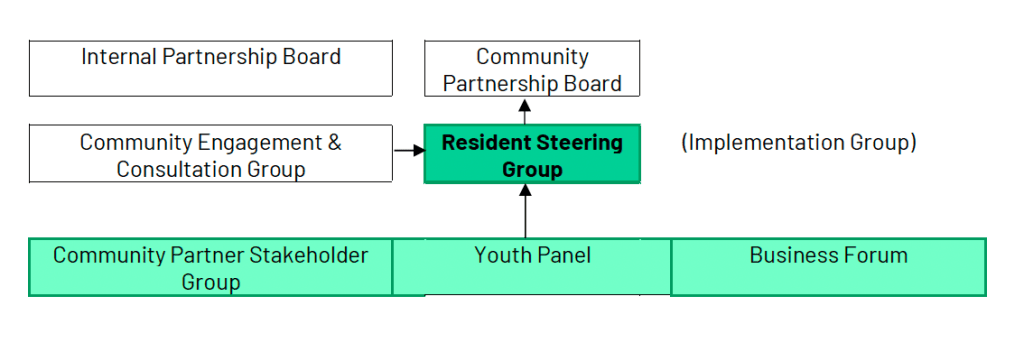
2.6 The steering group will therefore act as a partnership between resident representatives, other stakeholders and the project delivery team, making judgements and feedback based on technical and policy advice
3.0 Aims and objectives
3.1 To enable members of the Steering Group to provide informed perspectives about the proposals, processes, and performance in relation to the Ladywood regeneration programme.
3.2 To provide officers and representatives from BCC, other agencies, and consultants opportunities to advise members of the Steering Group about the proposals, processes, performance targets, management and monitoring for the Ladywood regeneration project and any other related BCC or approved stakeholder initiatives.
3.3 To allow all stakeholders, Steering Group members and officers to work in partnership with each other in a positive and proactive environment; ensuring that the residents directly affected by the Ladywood Regeneration receive accurate information, are fully consulted with and able to give their views about what is proposed throughout the project, in accordance with legal and regulatory expectations and social housing sector good practice.
3.4 To ensure that residents are fully informed about their rights and that all processes reflect their rights and entitlements.
3.5 To support residents in having the best possible experience during this process and that all proposals have been designed as best they can to reflect the communities’ needs and aspirations.
3.6 Contribute to effective, balanced and evidence-based decision making, effective governance and administration in line with the policies and expectations of BCC.
3.7 Influence associated community investment and social value proposals so they align with the local communities’ priorities.
4. Membership
4.1 The Steering Group members here refers to those who have authority to make decisions and have voting rights.
4.2 The steering group will comprise up to 17 voting members
These will include
- 6 x Birmingham City Council Tenants
- 4 x Homeowners: Leaseholders/Freeholders
- 1 x Housing Association Tenant
- 1 x Private Rented Sector Tenant
- 1 x Young Person
- 1 x Local Community Organisation
- 1 x Faith Organisation
- 1 x Business
- 1 x Independent Chair
4.3 The Steering Group shall review the membership make up and selection on a 12 monthly basis throughout its lifetime of its operation with the expectation that social housing tenant membership should always make up at least 60% of the Steering Group membership. The Steering Group membership should always aim to be as demographically representative of the Ladywood estate as possible.
4.4 Given the regeneration project will involve different phases that will affect different parts of Ladywood the Steering Group should ensure that a significant number of resident representatives are from affected areas.
4.5 The Steering Group may also co-opt any people with particular skills or who are significant stakeholders to attend meetings as non-voting members.
4.6 The Independent Tenants and Residents Advice provider (ITRA) will Chair the Steering Group for at least the first 6 months of the Steering Groups activity (the chair would not have a vote at this stage), with the expectation that a Steering Group member will succeed as Chair (with voting rights), with the ITRA then acting as Deputy Chair after this period.
4.7 The Steering Group will review it’s need for any further officers (e.g. treasurer, secretary etc) on a regular basis and agree any such posts following a vote of the Steering Group.
4.8 A Steering Group member can retire from the panel by giving the Chair notice in writing (including email). Retirement will be effective by the acknowledgement of the notice at the next Steering Group meeting, and a new member will then fill the vacant position from that stakeholder group.
4.9 Members of the Steering Group who do not attend 3 consecutive Steering Group meetings and do not provide an acceptable explanation for their absence will be initially made aware that persistent non-attendance will result in removal from the Steering Group. A replacement member would then be recruited in line with the agreed structure of the partnership and via an open recruitment process.
4.10 All Steering Group members are expected to support the broad aim of improving the social, economic and environmental wellbeing of Ladywood and the legitimacy of the BCC project team and of this Steering Group role in progressing this project. This does not mean they have to agree with every proposal made, but they cannot continue to be a member if they cannot support the legitimacy of the project or the Steering Group.
5.0 Conduct
5.1 Members of the Steering Group must conduct themselves in a reasonable manner at all meetings and in connection with all issues in relation to the Steering Group. (Please see Code of Conduct that all Steering Group members automatically agree to adhere to as a condition of joining the Steering Group as set out in Appendix A)
5.2 The Steering Group has the power to remove a member where there has been misconduct or impropriety. To do so a member must raise a motion for dismissal with the Chair of the Group who will convene a Steering Group meeting. The motion for dismissal will be voted on and decided by a majority vote. (This process is detailed in Appendix B).
6.0 Meetings
6.1 Meetings will normally be held monthly, but this can be varied by agreement of the members of the Steering Group. Meetings may take place in-person, online, or hybrid.
6.2 Meetings will generally be closed to the wider public and attended by the members of the RSG and invited guests, however with the agreement of the group, it may periodically designate meetings as open where interested parties can attend as observers,
6.3 Prior to meetings, Steering Group members will be contacted to agree proposed agenda items for meetings and the Chair and Vice Chair will confirm the proposed agenda for the meetings. A representative of the ITRA will attend every Steering Group meeting to give independent advice to the Steering Group, provide reports and briefings and will provide secretariate support to the Group. The ITRA will also provide support to Steering Group members as requested.
6.4 Quorum: at least 60% of Steering Group must be present for decisions to be valid. Most decisions should be made by general agreement, and the Steering Group should make every effort to arrive at a consensus view before going to a vote. In the unlikely event that there were a majority of non-residents at a meeting, the meeting could go ahead, but any proposed decisions items deferred.
6.5 Members of the Steering Group can call for a vote on an issue that that is directly linked to the Ladywood Regeneration Project and does not breach the aims and objectives of the group. The Chair can also call for a vote if consensus on an issue cannot be reached. All Steering Group members will be eligible to vote on a decision or a proposal unless they are coopetes. Members can vote yes no or abstain by a show of hands in the meeting. Each member shall have one vote on an issue. All issues shall be decided on a straight majority, in the event of a tie, then the Chair has the casting vote or, at their discretion, the option to ask for a different proposal to be prepared.
6.6 All members must declare any conflicts of interest at the commencement of the meeting, where there is a material conflict, then the member should remove themselves from the discussion and decisions on a particular agenda item. All conflicts of interest will be minuted for the record.
6.7 Officers from BCC and from other stakeholder organisations may attend to support the group as required. Officers may attend specifically to present a particular proposal, briefing or progress report and/or attend the meeting to be available to provide information, reports, advice, and guidance on various topics as discussed. Officer attendance will be managed by the Chair on a meeting-to-meeting basis but is ultimately a matter for the Steering Group to determine. The Steering Group can also request relevant officers to attend a Steering Group meeting if they feel this would be helpful.
6.8 Attending officers are also expected to observe the Steering Group Code of Conduct.
6.9 Officers should also advise Steering Group members of any matters that are confidential and/or sensitive and therefore should not be discussed outside of the Steering Group. If the officer is not sure about confidentiality, they should discuss it with the Chair and/or head of the project team before the meeting if possible.
6.10 Officers or any other stakeholders, consultants or representatives cannot vote on an issue but can contribute to any discussion subject to the Chair’s guidance.
7.0 Role of the Independent Tenant and Resident Advisor
7.1 An Independent Tenant and Resident Advisor (ITRA) has been appointed to provide independent support and advice to Steering Group members regarding their roles and the issues they are required to address.
7.2 The ITRA’s role is to ensure that Steering Group members have access to guidance and support on best practice, policy, implementation, and communication matters during and between meetings. The primary purpose of the ITRA, in this context, is to ensure that Steering Group members have access to relevant information upon which they can base their judgement of proposals. Where appropriate the ITRA will advocate on behalf of the RSG in issues related to recognition, process and communication, but not in respect of potential options or alternative proposals.
7.3 Further, the ITRA have a supporting role in enabling agreed training and development for the Steering Group members as identified to help them fulfil their role.
7.4 In addition, the ITRA will provide support and advice re governance and capacity building for the group and will undertake the chairing role in the first six months of the Steering Group to develop its core functions including a governance structure.
8.0 Equality, Diversity and Equity
8.1 The Steering Group will adopt the current Equality and Diversity Policy of BCC.
8.2 The Steering Group should ensure that equality, diversity and equity (fair outcomes) is a consideration in all of its deliberations.
8.3 It will also review its equality, diversity, and equity performance annually.
9.0 Support and resources
9.1 Steering Group members will receive:
- Training and briefings on key topics (planning, design, housing policy, decants, social value)
- Administrative support and access to meeting materials
- Reimbursement for reasonable expenses such as travel, childcare, or accessibility costs
10.0 Communication and Engagement
10.1 The Steering Group will:
- Share updates with the wider community through newsletters, estate meetings, and digital channels
- Encourage feedback from all residents in the regeneration area
- Work with BCC and ITRA ensure transparent communication
- Approve public summaries of meeting minutes for publication
10.2 Members should be mindful of confidentiality in respect of what is discussed in the Steering Group and should not discuss any issue that officers have highlighted as confidential in Steering Group meetings. This may relate to commercially sensitive information or issues under discussion that if discussed prematurely may cause unnecessary concern to community members or stakeholders. Furthermore, members should abide by and support Steering Group decisions when representing the Steering Group in the wider community and not seek to undermine the Steering Group’s activity by briefing against the group. Finally, members should not share personal or sensitive information regarding Steering Group or wider community or stakeholder details in line with the principles of data protection. Any such actions outlined previously that bring the Steering Group into disrepute, may be considered as misconduct.
11.0 Governance and accountability
11.1 The Steering Group will report to the BCC Regeneration Team and, where appropriate, the Project Board. BCC will respond to formal recommendations or questions raised by the Steering Group in writing. The Steering Group will review its own effectiveness annually and update these Terms of Reference as needed. Any concerns or disputes will be escalated to the BCC Regeneration Lead for resolution.
12.0 Review of Terms
12.1 It is anticipated that the Steering Group’s role, activities, powers, membership and governance will evolve over time as the project develops and will be subject to regular review by the Steering Group and BCC. These Terms of Reference will be reviewed annually or earlier if requested by the Steering Group or BCC, to ensure they remain relevant to the stage of the regeneration programme.
13.0 Appendices
- Appendix A: Code of Conduct
- Appendix B: Declaration of Interests Form
- Appendix C: Sample Meeting Agenda & Minutes Template
- Appendix D: Project Timeline & Key Milestones – To be developed
- Appendix E: Glossary of Terms – To be developed
Ladywood Resident Steering Group – Declaration of Interest Form
1.0 Purpose
1.1 This form is designed to promote openness and transparency in the way Ladywood RSG operates. It enables members to declare any personal, financial, or business interests that could influence—or be perceived to influence—their decisions or actions in relation to the group’s activities.
1.2 Please complete the details below. If your circumstances change at any time, please request and complete a new form to ensure your declaration remains up to date.
Full Name: ______________________________________
Role within the RSG – Please tick the relevant boxes
| Number | Role | Tick |
| 1 | Birmingham City Council Tenant | |
| 2 | Homeowner | |
| i | Leaseholder | |
| ii | Freeholder | |
| 3 | Housing Association Tenant | |
| 4 | Private Rented Sector Tenant | |
| 5 | Young Persons Representative | |
| 6 | Local Community Organisations Representative | |
| 7 | Faith Organisations Representative | |
| 8 | Business Representative |
2.0 Employment, Consultancy or Business Interests
2.1 In the box below please list any employment, self-employment, directorships, partnerships, or other business interests that may be relevant to your involvement in this group.
☐ None
3.0 Membership or Involvement in Other Organisations
3.1 In the box below please list membership of organisations including charities, community organisations, political or campaigning groups that could be connected to the work of this group.
☐ None
4.0 Family or Close Personal Connections
4.1 In the box below list any close family members or associates who might benefit from or be affected by decisions made by this group.
☐ None
5. Financial or Other Interests
5.2 In the box below list financial / other interest list such things as grants, contracts, land or property ownership, or any other financial interests that might be relevant.
☐ None
6. Declaration
6.2 I confirm that the information given above is accurate and complete to the best of my knowledge. I agree to notify the Chair of Ladywood RSG if there are changes to my interests as soon as they arise.
| Signature: |
| Date: |

 Ladywood Unite
Leave a reply to observant9c39d0f6d7 Cancel reply